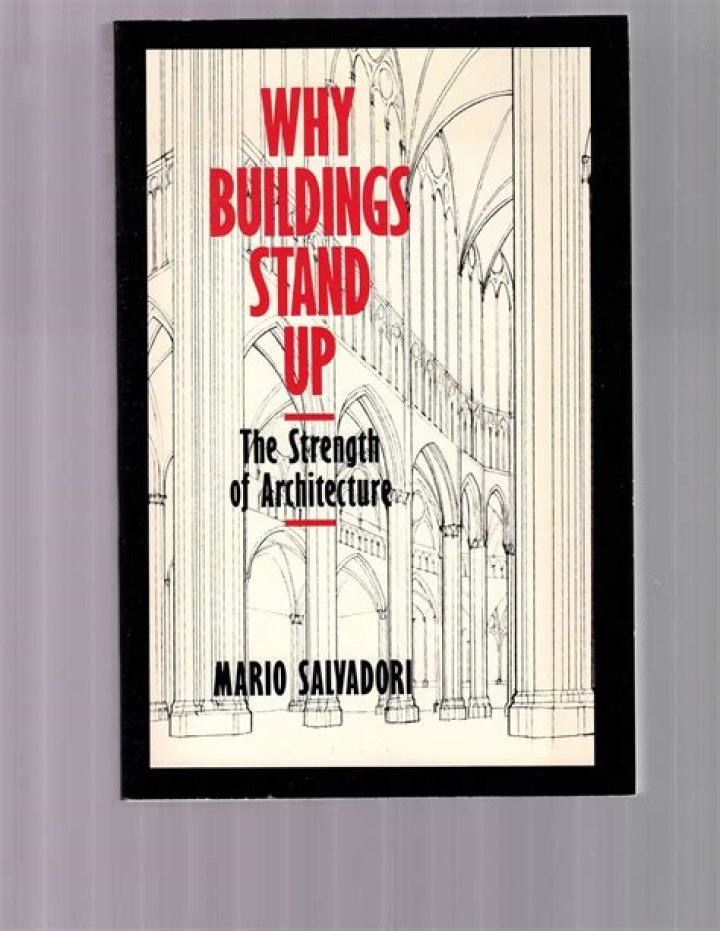
Why buildings stand up mario salvadori

James Sullivan
Published Mar 16, 2026
There are other answers below:
8 hàng · Why Buildings Stand Up. : Mario Salvadori. W. W. Norton & Company, 1990 – Architecture – 323 …
Why buildings stand up : the strength of architecture by Salvadori, Mario, 1907-1997; Hooker, Saralinda; Ragus, Christopher
‘Readers will rejoice… in the physical discoveries, ancient and modern, that create and govern the artifacts inside of which readers spend most of their natural lives.’— New York Times , Why Buildings Stand Up, The Strength of Architecture, Mario Salvadori, 9780393306767
‘Readers will rejoice… in the physical discoveries, ancient and modern, that create and govern the artifacts inside of which readers spend most of their natural lives.’— New York Times , Why Buildings Stand Up, The Strength of Architecture, Mario Salvadori, 9780393306767
It is a commonplace that every structure, from home to church to school to jail, sends a message to the onlooker. Salvadori argues that “structure too has a message of its own: it can be a message of strength or elegance, of waste or economy, of ugliness or beauty.”
An introduction to building methods from ancient times to the present day. In the afterword (to the 1990 pbk. ed.), the author discusses recent advances in science and technology that have had important effects on the planning and construction of buildings: improved materials (steel, concrete, plastics), progress in antiseismic designs,
WHY ^ BUILDINGS STAND UP — “«v All structural materials given limited values. When behave elastically the loads if, the loads are kept within grow above these values, materials develop deformations larger and no longer proportional to the loads. These deformations, which do not disappear upon unloading, are called permanent or residual deformations.
In order to Download Why Buildings Stand Up: The Strength of Architecture or Read Why Buildings Stand Up: The Strength of Architecture book, you need to create an account. Category: Book. Binding: Paperback. Author: Salvadori, Mario. Number of Pages: 324. Amazon Page : Amazon.com Price : $14.05.
As a structural engineer, Salvadori became known for the design of thin concrete shells as he strove to create great architecture in all of his projects, including the concrete structural system for the CBS Building in Manhattan, designed by Eero Saarinen, and the seashell-inspired restaurant building at the hotel La Concha, in San Juan, Puerto Rico.
Contents
| Structures | 17 |
| The Pyramids | 27 |
| Loads | 43 |
| Materials | 59 |
| Beams and Columns | 72 |
Oct 14 2021
Loads: 43Materials: 59Structures: 17The Pyramids: 27Related Questions
Who is Mario Salvadori and what did he do?
Mario G. Salvadori was a structural engineer and professor of both civil engineering and architecture at Columbia University.
What did Salvadori do with the key to the box?
While in the U.S., Salvadori stored some goods in a safe deposit box and left the key with Raymond D. Mindlin, whom he had met in New York a few months before, after a conference about the activities of Picone’s institute. When he returned to Italy, he saw that there was no hope for a positive change in the political environment.
Why buildings stand up is a good book?
Why buildings stand up is an interesting account of the science of construction in a historical perspective. It is really easy to read even for a person with no background in architecture or engineering while at the same time being fun since the theory of building is continuously supplanted by awesome historical examples.
What is Salvadori’s book about?
Salvadori examines classic structures of the west, from antiquity through the medieval and baroque periods, illustrating his concise primer on structures (beams, columns, loads etc) many are familiar with.